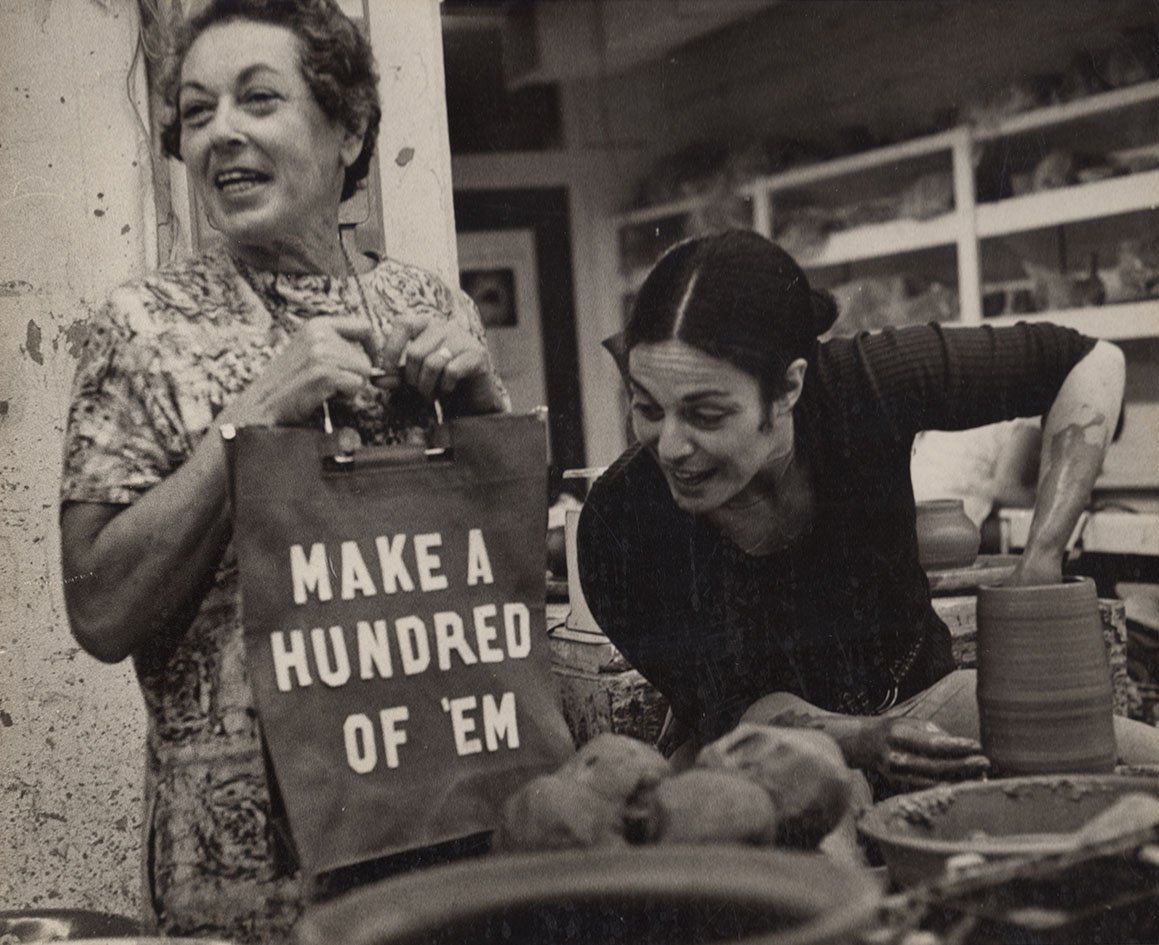
Estelle Halper (1918–1980) (left)
Estelle Halper was an acclaimed potter born in White Plains, New York in 1918. She studied ceramics at Greenwich House, painting at the Art Student’s League and art history at New York University. She initially lived and worked in New York City and in 1948 moved to Eastchester, New York residing there until her passing in 1980. She was a staff instructor at the Westchester Art Workshop and founded the pottery program at the Hudson River Museum where she taught from 1956 - 1978.
Halper's ceramic work was primarily stoneware, fired in an electric kiln. She developed formulas for her own glazes, many of which were “volcanic” glazes. Her work was featured in group shows at The Metropolitan Museum of Art, The Contemporary Crafts Museum, The Everson Museum, The American Museum of Natural History, The Cooper Union Museum for the Arts of Decoration, the Wadsworth Atheneaum, Lever House and The Denver Art Museum. She had solo exhibitions at America House (1952), Rabun Studio (1951-53) Hudson River Museum, Silvermine Guild of Art and Philadelphia Art Alliance, as well as in many private galleries. Her work was sold through several NYC galleries including America House, Bonniers and George Jensen.
She was internationally recognized and was invited and participated in seminars in Sweden, Greece and Turkey. In 1975 she went to Barcelona to study Gaudi sculpture. Her pottery and sculpture were given numerous awards in the greater New York area, and she holds the honor of being the first American woman artist whose work was purchased by Cartier in New York City. She has been listed in Who's Who in American Art, Who's Who of American Women, and Who Was Who In American Art: 1964-1975.
Halper initially took ceramic classes at Greenwich House Pottery in Manhattan in the early 1940’s, when she and her husband, Louis, lived on University Place in Greenwich Village. Prior to that she was an expert seamstress/embroiderer and taught sewing classes at the Singer Sewing Company in New York.
Lou Halper, a pharmacist, had a pharmacy in the Village that was frequented by many actors and artists in the 1940’s. While he mixed elements for prescriptions, Estelle was learning to mix elements for glazes at Greenwich House Pottery, taking courses with James Crumrine, and Ilsa Rothmer. In 1952, she attended a workshop given by Bernard Leach and Shoji Hamada and summer workshops with Peter Voulkos in 1960-62 and 1964, all given at Greenwich House Pottery.
Influenced by the simplicity of the classic forms of Japanese, Chinese and Greek pottery, she initially based her designs on these classic forms, later developing her own personal approach to ceramics and design. She worked with stoneware clay, while sculptural works were made of stoneware with grog. All were fired to cone 10 in an electric kiln. She experimented with various clay bodies and mixed her own clay in a pug mill in her studio in Eastchester, New York. Best known for her volcanic turquoise and blue glazes, these were developed while experimenting in her studio in the early 1950’s.
As the 1950’s were a time of Space exploration, she became interested in the terrain of planets and outer space textures and colors. She developed her volcanic glazes in a manner that had a texture that she felt would have been at home on Mars or the Moon. She joked that her pots looked as though they may have grown organically on another planet.
During the 1950’s her style became ever more eclectic, integrating classic forms with her unique manner of expressing emotion through innovative ceramic design. Many of her sculptural forms were inspired by nature – gourds, pods, sea forms and vegetation - which led her to dramatically alter her ceramic forms while evolving a more sculptural and abstract approach to her pottery. Further, Halper’s expressive use of glazes on plates and vessels reflects the influence of the Abstract Expressionists on her work. Their visions nourished her love of color fused with the expression of intense emotions. She focused on the beauty in life, harmonizing her vision in the form, design, and color of each piece to create emotional impact.